


|
Pearson Medical
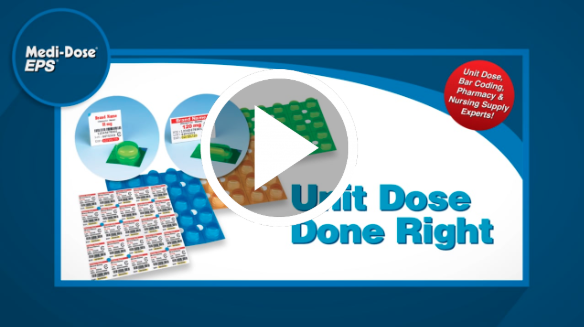
Pearson Medical Technologies provides safe and efficient bar coded unit dose packaging equipment and bar code labeling software to hospitals and long term care pharmacies for packaging and labeling of tablets, capsules, oral solids, liquids, ampoules, vials, and syringes. Pearson Medical's mission is to enhance patient safety and increase pharmacy productivity by providing innovative, efficient, and affordable medication delivery systems. Pearson Medical's vision is to help hospital, long-term care and retail pharmacies improve patient safety by providing cost-effective bar coded unit dose and labeling solutions that will help institutions become 100% barcode compliant.
Adding any one or a combination of Pearson products to your existing or new unit dose packaging and labeling operations will allow you to achieve a higher level of safety standards for your patients and increase your efficiency by reducing labeling or packaging errors.
Our core product, m:Print® Bar Code Labeling Software, should be an essential piece to any pharmacy packaging program because of its versatility and universal compatibility with any unit dose packaging system you may already use.
m:Print® Bar Code Label Printing Software
m:Print is stand alone software, that allows users to begin the labeling process within minutes of receiving m:Print.
m:Print allows every pharmacy to increase efficiency and accuracy of its unit dose labeling. Because m:Print is a standalone software and because m:Print has the ability to label virtually everything in the pharmacy, any pharmacy can instantly become bar code compliant.
m:Print is available in three editions: Premium, Basic, and Academic. Please visit our website to determine which edition is right for your pharmacy.
m:Print Premium features include:
- Three databases from First DataBank, including:
- NDDF database with over 134,000 records;
- Drug Image database with over 34,000 records; and,
- Tall Man lettering database for look-a-like/sound-a-like drugs.
- Pre-designed label templates or create your own templates to meet your pharmacy’s specific need.
- Print labels in color with any inkjet printer.
- Print drug images on label to reduce medication errors.
- Import your own drug images.
- On-screen Pharmacist Approval tracking of all labels.
- On-screen Reports which can be modified for you facility.
- Export Reports to Excel spreadsheet for analysis.
- Print on sheet labels or roll labels.
- Use with your existing manual packaging material.
- Quarterly updates to software and First Databank Databases.
IP128APS Automated Packaging System
¼ THE SIZE AND ½ THE PRICE!!!!
Pearson Medical Technologies introduces the latest addition to its line of bar coded unit dose and multi-dose solutions. The IP128APS is the most cost-effective fully automated high-speed unit dose and multi-dose packaging system available with the smallest footprint available. Increase patient safety by reducing medication administration errors, while improving pharmacy efficiency.
The IP128APS increases pharmacy productivity and efficiency by reducing staff requirements and optimizing workflow and inventory through unattended packaging operations.
The IP128APS is an automated canister system that creates packaging in single unit dose or multi-dose packages for patient specific and unit dose package runs. This automated system is ideal for long term care pharmacies for short cycle filling as well as hospital pharmacies for unit dose packaging. The IP128APS packaging unit is perfect for any pharmacy because of its compact size and its low price.
Some of the IP128APS features include:
- Footprint: 2' x 2'
- Fill multiple canisters with fast moving drugs.
- Multiple package sizes.
- Print Linear (1-D) bar codes and 2-D bar codes such as Aztec or Data Matrix.
- Up to 20 tablets or capsules per package.
- Refill Canisters while packaging is in progress.
- Manual Tray Unit for overflow drugs.
- On-board Dehumidifier keeps pills dry.
- m:Print® Bar Code Labeling Software for label design.
- Canister design prevents canisters from being loaded into wrong slot.
- Quick and Easy Print Ribbon Cassette Replacement
- Auxiliary label printer for use with clearTag® labels and other manual labels.
intelliPack®2 Automated Unit Dose Packaging System
The intelliPack®2 is a semi-automated bagging system used to package oral solids and over wrap exception items. This bagging system allows pharmacies to:
- Package oral solid tablets, capsules, and fish oils with the automated intelliCount® Universal Feeder.
- Manual tray for exception items.
- Robot-Ready bags for filling robotic systems.
- Over wrap bags for larger items.
- Over Wrap only units available.
- Auxiliary label printer for use with clearTag® labels and other manual labels.
- m:Print® Bar Code Labeling Software for label design.
iPack® T60 Unit Dose Blister Packager
The iPack®T60 is the first tabletop thermoform machine built specifically for pharmacies. The iPack® T60 allows pharmacies to package oral solids or liquids with custom designed tooling for each pharmacy. This thermoform system allows pharmacies to:
- Package tablets and capsules in blister at 60 per minute.
- Package liquids in up to 25ml units.
- Auxiliary label printer for use with clearTag® labels and other manual labels.
- m:Print® Bar Code Labeling Software for label design.
clearTag® Bar Code Labels
clearTag® Labels were designed to allow pharmacies to put bar code labels on syringes, vials, ampoules, and other small surface items that are difficult to bar code. The clearTag® label design ensures:
- Complete access/readability of manufacturer's label, including dosage, instructions for administration, expiration date, and other warnings.
- Use with any thermal transfer printer.
- Clear stem ensures ability to affix label to any unique surface.
- Freezer grade labels will not degrade integrity of the label or the bar code when exposed to freezing temperatures or condensation.
safeSealRx® Blister Card Heat Sealer
The safeSeal Rx® is a unit dose heat press currently used for packaging 30, 60, and 90 day heat seal blister cards for the long term care market. The automatic release feature on this unit is unique and allows pharmacy technicians time to prepare for their next packaging run during the seal time. The auto release also prevents over heating/sealing which could damage medications. The features of the safeSealRx® include:
- Automatic release so pills will not get overheated
- Digital setting and display of seal time
- Digital setting and display of temperature.
- Improved heating elements to improve sealing process.
- Pressure adjustment to improve sealing process.
- Floating upper platen to improve heat seal.
- Lifetime warranty on certain parts.
|
|
Pearson Medical Technologies, M:print®, M:print®-intelliPACK®, M:print®-Strip Packager, and M:print®-Labeler, clearTAG® labels developed for M:print users,
|
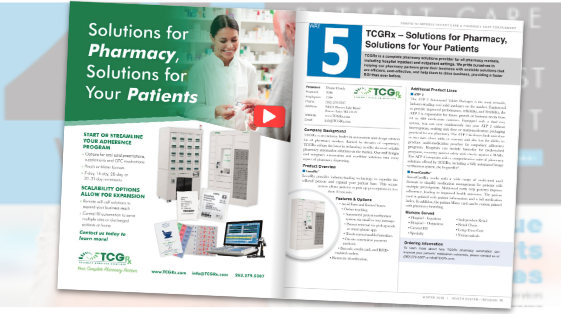
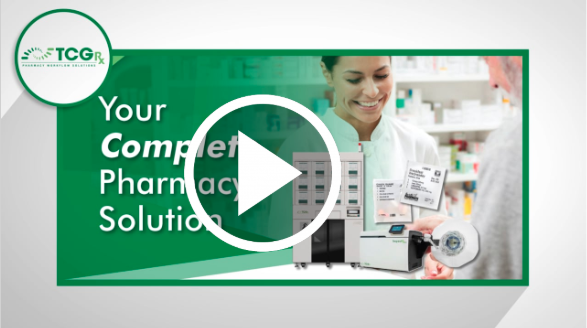
TCGRx
DRIVEN BY LIGHT, VERIFIED BY BARCODE
The ATP Series is the next generation technology for oral solid packing. TCG’s innovative and ground breaking software addresses market needs that have never before been addressed. The ATP Series is a practical, easy to use and innovative product that will keep your pharmacy up to speed now and in the future.
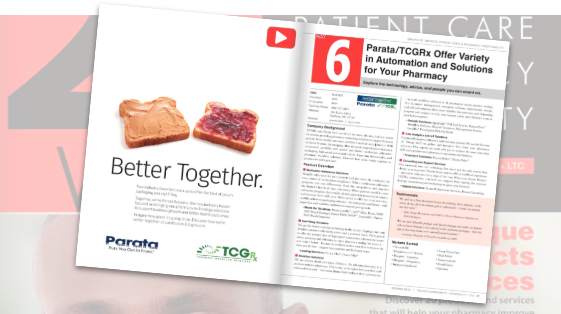
TCGRx offers pharmacy optimization across space, labor, and inventory. As demands on pharmacy have become increasingly more difficult to manage solutions have been offered to address the individual areas of need. TCGRx is the only company that looks at all facets of the pharmacy to bring a total solution that addresses today’s needs while leaving options open for the future.
ATP Series
Proven, Reliable, State of the Art…
Unit Dose and Multi-Dose Automation for all pharmacy settings and sizes.
Long Term Care and Assisted Living:
- The ATP-Series can facilitate a cost effective alternative to blister packages with automated unit dose pouch strips
- Hands free and high speed production of unit dose strips for box replenishment
- Multi-dose packages with medication capacity of up to 7 different medications and the ability to isolate expensive or controlled medications in individual packages in sequence with the other bags to facilitate ease of dispense as well as ease of return and control
- The unique ability to automate up to 710 medications across multiple devices handles high volume unit dose packaging needs
Hospital, Corrections, Clinics:
- TCGRx offers an ATP device that is suitable to the specific needs of any pharmacy. With the ability to scale from 256-320-384 medications, formulary can be added as needed.
- AUTOMATED, HANDS FREE, TABLETOP PACKAGER: The ATP-71 has been developed as an automated tabletop packager at an affordable price. It is the first of its kind on the market to offer entry level automation for any size hospital or pharmacy.
Pick To Light Technology
BEACON (Optical Positioning System) Storage and Retrieval System
The BEACON System is a powerful tool that will allow the pharmacy to grow and add new services, control inventory and optimize workflow
- Optimizes space, labor and inventory
- Adds more capacity
- Modular for easy reconfiguration
- Increases Accuracy
Services
Pharmatecture: Pharmacy Design
- TCG offers a full line of revolutionary high density storage. Our unique shelving and drawer systems allow us to optimize workflow, space, and inventory control.
- TCG employs a team of pharmacy designers and industrial engineers who can help with the integration of automation or storage and retrieval solutions that will meet the business needs of the pharmacy.
- Reduce your storage space by 50%
WHETHER YOU ARE ABOUT TO PURCHASE OR HAVE PURCHASED PHARMACY AUTOMATION or STORAGE AND RETRIEVAL SYSTEMS, TCGRx can be a valuable consultant and solutions provider for your pharmacy.
|
|
Pharmacy Automation, Pharmacy Workflow Solutions, TCGRx, Unit Dose Technology, Pharmacy Barcoding
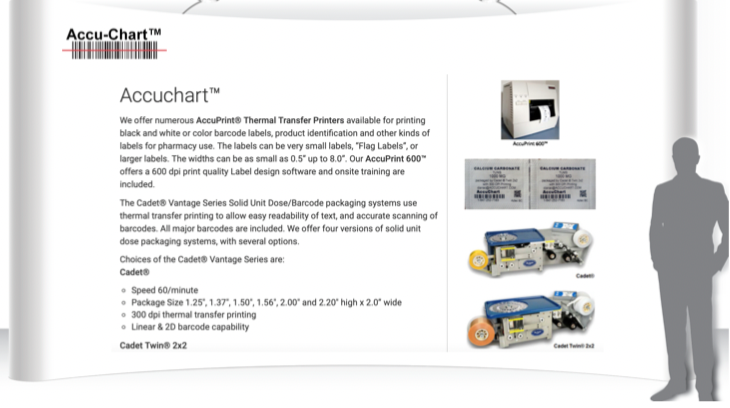
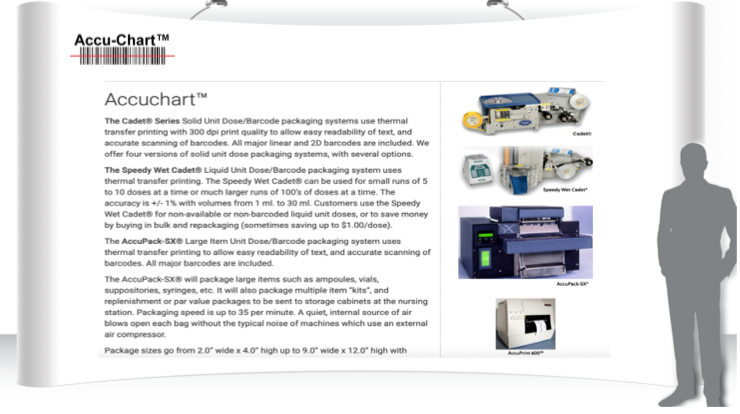
Accuchart™
We offer numerous AccuPrint® Thermal Transfer Printers available for printing black and white or color barcode labels, product identification and other kinds of labels for pharmacy use. The labels can be very small labels, “Flag Labels”, or larger labels. The widths can be as small as 0.5” up to 8.0”. Our AccuPrint 600™ offers a 600 dpi print quality Label design software and onsite training are included.
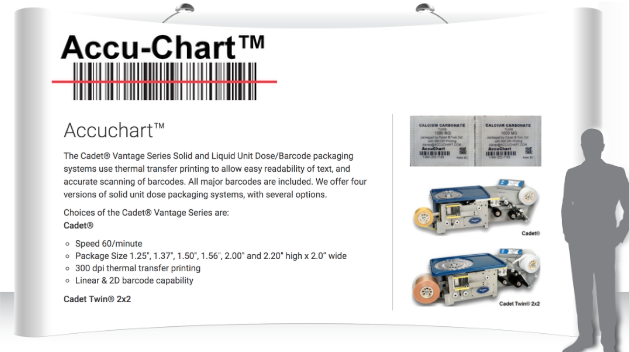
The Cadet® Vantage Series Solid Unit Dose/Barcode packaging systems use thermal transfer printing to allow easy readability of text, and accurate scanning of barcodes. All major barcodes are included. We offer four versions of solid unit dose packaging systems, with several options.
Choices of the Cadet® Vantage Series are:
Cadet®
- Speed 60/minute
- Package Size 1.25", 1.37", 1.50", 1.56", 2.00" and 2.20" high x 2.0” wide
- 300 dpi thermal transfer printing
- Linear & 2D barcode capability
Cadet Twin® 2x2
- Speed 120/minute
- Package Size 1.25", 1.37", 1.50", 1.56", 2.00" and 2.20" high x 2.0” wide
- 300 dpi thermal transfer printing
- Linear & 2D barcode capability
- Pill Camera
- Biometric Scanner
Cadet Twin®
Same as the Cadet Twin® 2x2, but with a 1.5” wide package size.
The Punch Cadet® does Robotic and Regular packaging:
Punch Cadet® (Robotic)
- Speed 30/minute
- Package Size 3.0” high x 2.5” wide
Punch Cadet® (Regular)
- Speed 60/minute
- Package Size 1.5” high x 2.5” wide
The Cadet® Vantage Series Liquid UD Packaging System
Liquid Unit Dose/Barcode packaging system uses 300 dpi thermal transfer printing. The Speedy Wet Cadet® can be used for small runs of 5 to 10 doses at a time or much larger runs of 100’s of doses at a time. The accuracy is +/- 1% with volumes from 1 ml. to 30 ml. Customers use the Vantage Speedy Wet Cadet® for non-available or non-barcoded liquid unit doses, or to save money by buying in bulk and repackaging (sometimes saving up to $1.00 per dose).
Speedy Wet Cadet®
- Maximum speed 32/minute
- Repeater™ Pump
- Cup Size 22 ml. or 44 ml.
- Linear & 2D barcode capability
- Password Protection
- Biometric Scanner
The Cadet®, Cadet Twin®, Cadet Twin® 2x2, Punch Cadet®, and Speedy Wet Cadet® are trademarks of Euclid Spiral Paper Tube Corp.
|
|
barcode barcoding printer receipt ros star thermal rewriter card writer leuco magnetic strip ethernet interface semi automatic cleaning speed 3 track iso led display dot matrix label ticket Cadet® Series Cadet Twin 2x2 Cadet Twin Punch Cadet Speedy Wet Cadet Accu-Chart
|
|
TCGRx
TCGRx offers pharmacy optimization across space, labor, and inventory. As demands on pharmacy have become increasingly more difficult to manage solutions have been offered to address the individual areas of need. TCGRx is the only company that looks at all facets of the pharmacy to bring a total solution that addresses today’s needs while leaving options open for the future. |
Bar Code Direct
Bar Code Direct is a global provider of premier bar code equipment, printing systems, scanning and data collection terminals, supplies, software, and related services |
Pearson Medical Technologies
Pearson Medical Technologies offers customized solutions for healthcare professionals to better serve and provide for their patients by providing barcoding printers and software. |
Swisslog
Swisslog offers barcoding capability for any hospital pharmacy item, including drugs and supplies including IV bags, large injectables, bulk stock containers and inhalers. For more information about Swisslog and their products, visit the website provided. |
Talyst
Talyst is focused on providing innovative and reliable solutions for hospital and institutional barcoding and unit dose technologies. The AutoLabel system is a unique and accurate barcoding system assuring 100% of medications are scan-able at the patient's bedside. |
 |
|
 |
Achieving Cultural Competency: A Case-based Approach to Training Health Professionals
The Case of Carl Jones
48-year-old homeless Caucasian man with chest pain and lung cancer
Provided by: University of Pennsylvania School of Medicine
Learning objectives
Upon completion of this activity, participants should be better able to:
* Relate that physicians may have biases related to socioeconomic status that may influence their clinical decisions and ultimately patient care.
* Discuss how patient homelessness impacts physician attitudes and disease management.
* Demonstrate the ... |
 |
Pharmacotherapy in Addiction Treatment
Provided by: Pharmacy Society of Wisconsin
At the conclusion of this activity, the pharmacy technician should be able to:
1. Describe common signs and symptoms associated with chemical dependency.
2. Differentiate among terms relating to addiction such as physical dependence, chemical dependence, and pseudoaddiction.
3. List three drugs used in the management of chemically dependent pati... |
 |
Individualized Therapy For Nonsmall-Cell Lung Cancer: A Look At Histology
Provided by: ASiM
While progress has been made with nonsmall cell lung cancer (NSCLC) therapies, maintaining quality of life, and individualizing therapy for patients based on age, performance status, comorbidities, histologic subtypes and toxicities remain the top priority for healthcare providers. Unfortunately, treating patients with NSCLC involves many discipli... |
 |
Enhancing Your Pediatric Practice
Provided by: Vindico Medical Education
This issue of Pediatric Annals provides several examples and strategies of how students and resident trainees can be effectively integrated into a busy office practice. The challenges and rewards of embracing community-based medical education are clearly delineated. Additionally, the participant is introduced to the concept of office-based research... |
 |
Measuring for Improvement
Provided by: Institute for Healthcare Improvement
Measurement is essential in any improvement work: It tells you if the changes you are testing are leading to improvement. But measurement for improvement is different from measurement for research. In this course, you’ll learn how to use three basic kinds of measures: outcome, process, and balancing measures. You’ll learn how to collect, displa... |
 |
Chapter 1
Immunology Review I: Cells of the Immune System
Provided by: Projects In Knowledge, Inc.
Activity Goal
The goal of this CME/CE program is to address the clinicians' needs in assessing the role of the immune system in the underlying pathophysiology of common dermatologic conditions, current strategies for immunomodulation, and novel therapeutic strategies in the management of dermatologic conditions.
Target Audience
This CME/CE pro... |
 |
Choosing a Neurosurgical Practice
Provided by: American Association of Neurological Surgeons
This presentation gives an overview of the various neurosurgical practice types. It includes the pros and cons of various practice situations. Much attention is given to various compensation models. Insight into the value of established group practices to the new member is outlined as well as the value of established groups taking on new members.
... |
 |
Insights into Pain Management - Module 7: Multidisciplinary Pain Management
Provided by: University of Pennsylvania School of Medicine
Insights into Pain Management -
Module 7: Multidisciplinary Pain Management
Faculty: Michael A. Ashburn, MD, MPH, MBA (Chair)
Professor of Anesthesiology and Critical Care
Director, Pain Medicine and Palliative Care
University of Pennsylvania Health System
Philadelphia, Pennsylvania
Estimated Time to Complete: 1 hour
Credit: Up to 1 AM... |
 |
MRI of the Temporomandibular Joints
Provided by: PROSCAN Imaging Education Foundation
The ProScan Imaging Education Foundation's all-new Professional MRI Series provides a comprehensive educational program that encompasses a broad survey of up-to-date radiological knowledge in the neurological and musculoskeletal realms. Lectures address in-depth discussions of neuroradiology of the brain, spine, head and neck, and pediatric imaging... |
 |
Goals for Inpatient Diabetes Management
Provided by: University of California, Davis, Health System
Accreditation
The UC Davis Health System is accredited by the Accreditation Council for Continuing Medical Education (ACCME) to provide continuing medical education for physicians. This CME activity was planned in accordance with the ACCME essentials for enduring materials. Length of time has been determined to be 1.0 AMA PRA Category 1 Credit c... |
 |
The Role of Nonprescription Products in Pain Management
Provided by: Purdue University - College of Pharmacy
Learning Objectives 1) Recognize various pain-producing conditions that are amenable to self-therapy, such as headache, muscular injury and tendon damage, and differentiate them from conditions requiring physician care. 2) Recognize the various decision points at which patients should be referred to a physician. 3) Determine which nonprescription p... |
 |
Neuroreceptor Molecular Imaging of the Heart
Provided by: SNM Advancing Molecular Imaging and Therapy
Neuroreceptor Molecular Imaging of the Heart... |
 |
SNM Practice Guideline for Hepatobiliary Scintigraphy 4.0
Provided by: SNM Advancing Molecular Imaging and Therapy
No information... |
 |
Dysplasia Masses
Provided by: PROSCAN Imaging Education Foundation
The Cardiac MRI Series features Dr. Stephen J. Pomeranz's most intense and detailed review of cardiac MR applications as they relate to anatomy and microanatomy of the heart. The interpreter will learn how to master the assessment of pericardial disease, functional assessment, infarct sizing, mass assessment, and cardiac anomalies. Particularly cri... |
 |
MR BiRads Analysis
Provided by: PROSCAN Imaging Education Foundation
Breast MRI is reported as valuable in detecting cancer in women who have a personal history of breast cancer, those patients with greater than 25% lifetime risk of breast cancer, and those with dense breasts -a condition associated with breast cancer risk but which decreases the sensitivity of the gold standard screening exam, mammography. MRI help... |
 |
Celiac CME Central: Defining, Diagnosing, and Managing Celiac Disease
Provided by: Impact Education, LLC
Target Audience
This activity has been designed to meet the educational needs of primary care physicians responsible for routine care and follow up of celiac patients.
Statement of Need/Program Overview
Celiac disease is an autoimmune digestive disease that damages the villi of the small intestine and interferes with absorption of nutrients fr... |
 |
Code Sepsis: Clinical Microbiology's Role in the Diagnosis of Bloodstream Infections and Sepsis
Provided by: American Society for Clinical Pathology
Upon completion of this program, you will be able to:
* Explain the medical and operational impact of bloodstream infections and sepsis
* Delineate the limitations of blood culture practices
* Describe the rapid methods that are performed in microbiology as an adjunct to blood cultures
* Discuss the imperatives and needs for rapid repo... |
 |
EMTALA: An E.R. Law That Affects All Physicians, 2nd Edition
Provided by: Virtual Lecture Hall
* Recognize EMTALA laws and their effect on the practice of emergency medicine so physician decisions are in compliance with EMTALA laws.
Meets Special CME Requirements in: Connecticut, Massachusetts, Pennsylvania, Rhode Island, Texas ... |
 |
Diagnostic Value of Hemoglobin A1c and Fasting Plasma Glucose Levels in Coronary Artery Bypass Grafting Patients With Undiagnosed Diabetes Mellitus
Provided by: The Society of Thoracic Surgeons
After reading this article, the learner should be able to:
* understand the role as well as the sensitivity and specificity of fasting plasma glucose and hemoglobin A1c measurements for the diagnosis of diabetes
* become aware of the prevalence of diabetes in patients undergoing coronary artery bypass grafting
* recognize that while asy... |
 |
Glycemic Control in the ICU: New Technology for Better Care
Provided by: ProCE
Blood glucose management is a critical factor to optimize patient care outcomes in the ICU. Existing protocols for infusing IV insulin can result in poor or inconsistent glycemic control, as evidenced by cases of hypoglycemia and in miscalculations of insulin dosage. This program will demonstrate why advanced technology for managing IV insulin drip... |
 |
Focus On: Malaria
Provided by: American College of Emergency Physicians
After reading this article, the physician should be able to:
* Discuss the epidemiology of malaria.
* Identify the signs and symptoms of malaria in patients presenting to the emergency department.
* Identify several pitfalls in the diagnosis of malaria.
* Review the diagnosis and management of uncomplicated and severe malaria.... |
 |
MRI of the Pancreas Series -Introduction & Technique, Part I
Provided by: PROSCAN Imaging Education Foundation
The Master's Series features Dr. Stephen J. Pomeranz's most advanced lectures on diagnostic imaging to date. These intense and detailed presentations will focus on the topics of orthopaedic, neurologic, and body imaging. Each title in the series will examine subjects such as subtle interpretative techniques, anatomic detail, mastery of key technica... |
 |
Conducting Culturally Sensitive Psychosocial Research
Provided by: NetCE
The reality is that practitioners, including nurses, social workers, counselors, psychologists, and mental health workers, observe and interact with a variety of social problems and generally have questions about: the magnitude of the problem; the psychosocial ramifications on individuals, families, communities, neighborhoods, and society; its rela... |

 |
Substance Abuse and Chemical Dependency
Provided by: Academy of Dental Learning
Substance abuse, improper or excessive use of alcohol or other mood altering substance, occurs at an alarming rate in today's society. It is estimated that approximately 1:5 male patients in a dental practice abuse alcohol. Approximately 1:16 female patients have a substance abuse problem 1 alarming new trend is the misuse of prescription medicatio... |
 |
CT Angiography of Coronary Artery Aneurysms: Detection, Definition, Causes, and Treatment
Provided by: American Roentgen Ray Society
Peer-reviewed articles from American Journal of Roentgenology (AJR). This activity offers AMA PRA Category 1 Credit(s)(TM) following completion of an online test... |
 |
Root Cause and Systems Analysis
Provided by: Institute for Healthcare Improvement
This course introduces students to a systematic response to error called root cause analysis (RCA). The goal of RCA is to learn from adverse events and prevent them from happening in the future. The three lessons in this course explain RCA in detail, using case studies and examples from both industry and health care. By the end, you’ll learn a st... |
 |
Use of Home Pain Medications After Pediatric Orthopaedic Procedures
Provided by: American Academy of Orthopaedic Surgeons
After completing this CME module, participants will be able to
1. Describe current methods and tools to assess the level of pain in a child, including use of the FLACC, VAS, and FPS-R pain scales.
2. Explain patient-to-patient variability with regard to the categorization of pain.
3. Discriminate between the three main categories of p... |
 |
Gastrointestinal Cancers
Provided by: American Society of Clinical Oncology
Upon completion of this educational activity, participants will be able to:
* Identify knowledge and practice gaps relating to gastrointestinal cancers;
* Apply knowledge learned toward an enhanced ability to identify gastrointestinal cancer risks and recommend effective interventions for individual patients;
* Demonstrate participation in life... |
 |
Palliative Care: Essentials - Updated
Provided by: National Center of Continuing Education
For nurses in every specialty: the basics of caring for the client whose disease is not responsive to curative treatment. Emphasis is on pain management; dealing with emotional, psychosocial, and spiritual issues; and client rights.
Course objectives include:
Define and characterize palliative care.
Outline ways to address the emotional and ... |
 |
Women's Health for Dental Healthcare Professionals
Provided by: NetCE
Ongoing research and emerging information investigating possible mechanisms of action and confirming links between oral health and a woman's overall well-being makes it imperative that dental professionals expand their knowledge of medicine. The information in this course has relevance and application to the daily practice of dentistry as the consc... |
 |
|
|